
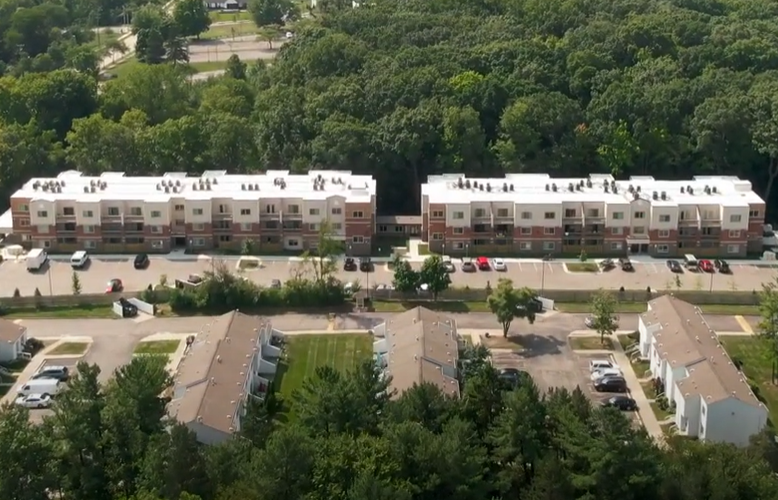
Avalon Housing has been awarded Low Income Housing Tax Credits which will bring in approximately $10,000,000 in tax credit equity for the third phase of the Hickory Way Apartments campus in Ann Arbor. The Michigan State Housing Development Authority (MSHDA) announced the awards in December.
The tax credits will pay for about 60% of the total cost of the project, which will add 39 one-bedroom units to the existing 70 units at Hickory Way. Securing the tax credits will allow Avalon to move forward in pursuing the remainder of the funding needed; depending on how that process goes, construction could start in the late summer or fall of 2026, with the project opening to tenants in late 2027 or early 2028.
“We’re really excited to be able to add more local housing to help address homelessness in our community,” said Wendy Carty-Saxon, Avalon’s Director of Real Estate and Development. “We have seen what a difference it makes on an individual and community basis!”
Other funding sources for the project include federal HOME and HOME ARP projects allocated through Washtenaw County; the City of Ann Arbor Affordable Housing Millage; a payment in lieu of taxes to the city that lowers the project’s property taxes; Washtenaw County Brownfield Program, construction loans from the Huntington National Bank and Chelsea State Bank; and pre-development funding from the Corporation for Supportive Housing. National Equity Fund is the investor limited partner.
The City of Ann Arbor helped Avalon acquire the land by exercising its “right of first refusal” – when the previous owner sold the plot, the deed allowed the city to purchase it before any other buyer. The city bought the land, and entered into a purchase agreement with Avalon at cost, which was approximately $260,000.
“When so many parts of a community come together – the federal level, the county board, the City of Ann Arbor, and our partners in banking and finance – we can do great things to address homelessness and make sure all of our neighbors have a safe place to call home,” said Avalon Housing Executive Director Aaron Cooper.
Twenty-four of the new units will have project-based housing vouchers, meaning rents cannot exceed 30% of tenants’ income. Twenty of those apartments will be set aside for people directly leaving homelessness, and 4 will also be open to people who are homeless or at risk of homelessness.
Avalon provides all residents access to support services to help them thrive, including help addressing food insecurity, on-site health care, and transportation to critical appointments, among others.
When the first phases of Hickory Way opened in 2021, the rate of chronic homelessness in the county fell by 31%.
Contact: Dan Meisler, Communications Manager, Avalon Housing
[email protected], 734-209-1491
Avalon Housing works to build healthy, safe and inclusive supportive housing communities as a long-term solution to homelessness. Since its founding in 1992, Avalon Housing has led the development, construction and management of high-quality, permanently affordable housing across Washtenaw County. For more information, visit AvalonHousing.org.
The Corporation for Supportive Housing has been the national leader in supportive housing for over 25 years. It has worked in 47 states to help create stable, permanent homes for individuals and families. This housing has transformed the lives of over 200,000 people who once lived in abject poverty, on our streets or in institutions. A nonprofit Community Development Financial Institution (CDFI), CSH has earned a reputation as a highly effective, financially stable organization with strong partnerships across government, community organizations, foundations, and financial institutions.
Its loans and grants totaling over $600 MM have been instrumental in developing supportive housing in every corner of the country. Through our resources and knowledge, CSH is advancing innovative solutions that use housing as a platform for services to improve lives, maximize public resources, build healthy communities and break the cycle of intergenerational poverty. Visit csh.org to learn more.